I have never thought about smell as a defined artistic medium. I probably shouldn’t admit that, because I am about to write about smell as a defined artistic medium, using it as a thread between three artists’ practices. I can’t help but admit it: smell is ephemeral, invisible, intangible. I can’t hold it, can’t see it, I don’t know how to speak about it really. It just happens to me, passes over like a cloud and then I am left scrabbling for words, trying to figure out what *that* just was (to explain it to you, sure, but also to explain it to myself).
When I am writing or describing something, I want to do this vicarious thing where I am being so comprehensive and accurate that you and I know exactly what I mean, just through the specificity of my description. I seem to believe in the power of language to bring us so close together, our minds might as well be physically touching. This is, of course, a fantasy. Smell is a category where language often fails because it is insufficient. There is a limited set of words in the English language to describe smells. We mostly outsource: we rely on other senses (taste, but sometimes others — sharp, soft refers to touch), we rely on the source (floral, woody), we revert to a language of similes, metaphors, and parallels. When I write about smell, I have to add another degree of separation between you and me, find a likeness and hope that your understanding of the likeness is the same as mine.
When I am writing about smell as a medium, communicating the particulars of what the smell smells like is only half the point. It’d be like describing the exact kind of red Bacon is using — worthwhile, but there are other things (screaming popes etc.) going on.
I encountered these three works at the artists’ respective MA/MFA degree shows (between the Slade and Goldsmiths). In the works, smell is both a human sense and also a device with a conceptual function. It performs a component task within the artwork’s wider whole. In James Milner’s Room (Manrose Gold), the entire installation feels like an elaborate ruse to set the scene for the smell. Here, the intangibility of the medium feels like the terms of its use. In Kaja Upelj’s We Live in an Era of Saint Making, smell comes out of a process of collaboration with perfumer Alina Miron. It functions like a parallel feeling, an idea running between sculpture and smell. In Ella Fleck’s aria, smell is like white noise — a chronic background hum. It functions more like a found object, dragging all of its contextual baggage into the conversation.
So, in order: experiential transcendence, mirror image, found object. If smell is a discrete medium, the medium is not actually fixed. You can take this essay as a whole, documentation of work that (by its very nature) fades away. To be a critic is to be overly concerned with this kind of second order activity. But part of me thinks this is actually three separate texts, bound together by smell as a gestalt. A brief study of the medium, as it stands in London in summer 2026. Maybe, at the end, it’ll feel defined. Maybe it’ll feel more nebulous, slippery gas, ephemeral, invisible, intangible. I have high hopes for the latter, but I try not to make promises.
JAMES MILNER, Room (Manrose Gold), 2026, at the Slade MA degree show
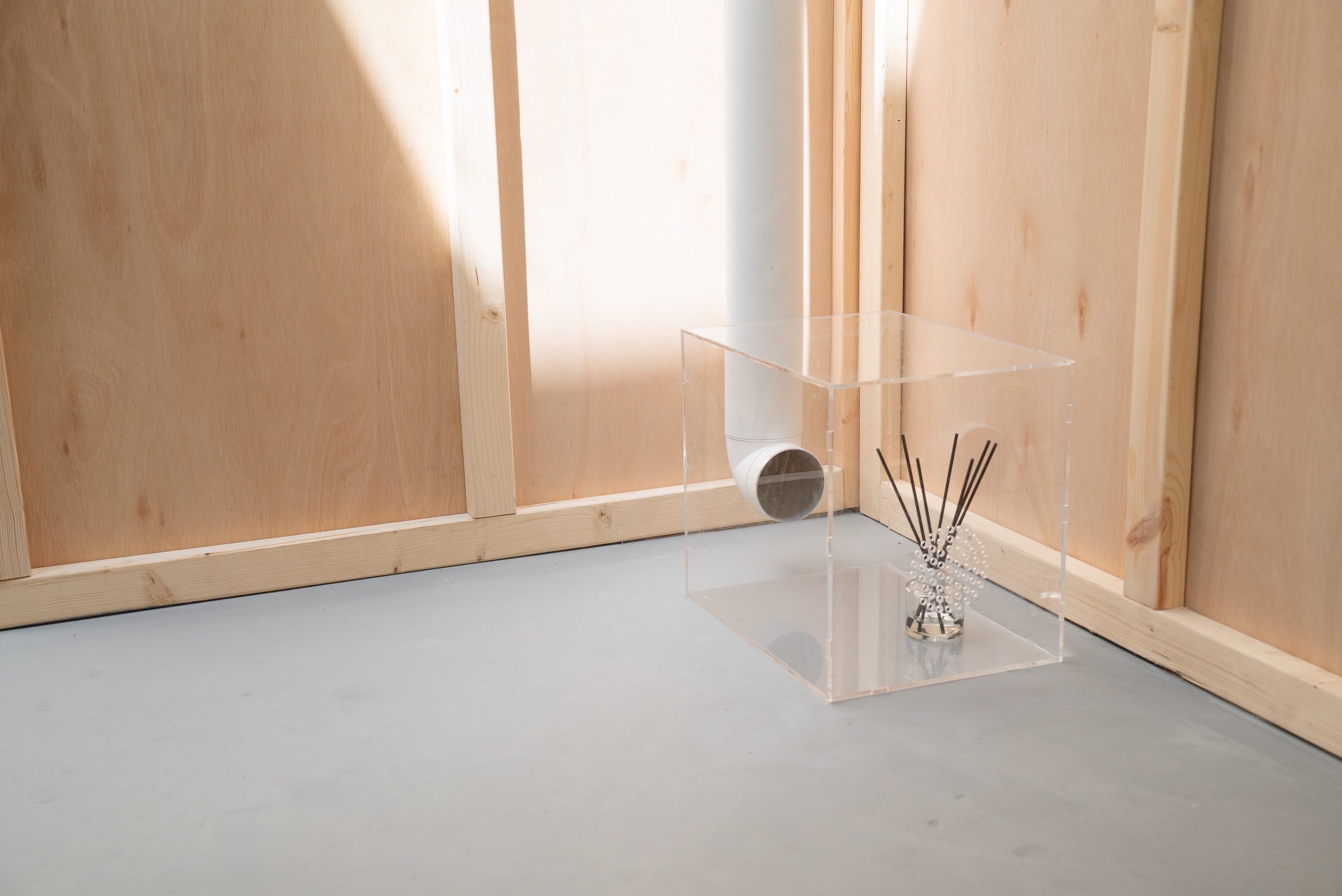
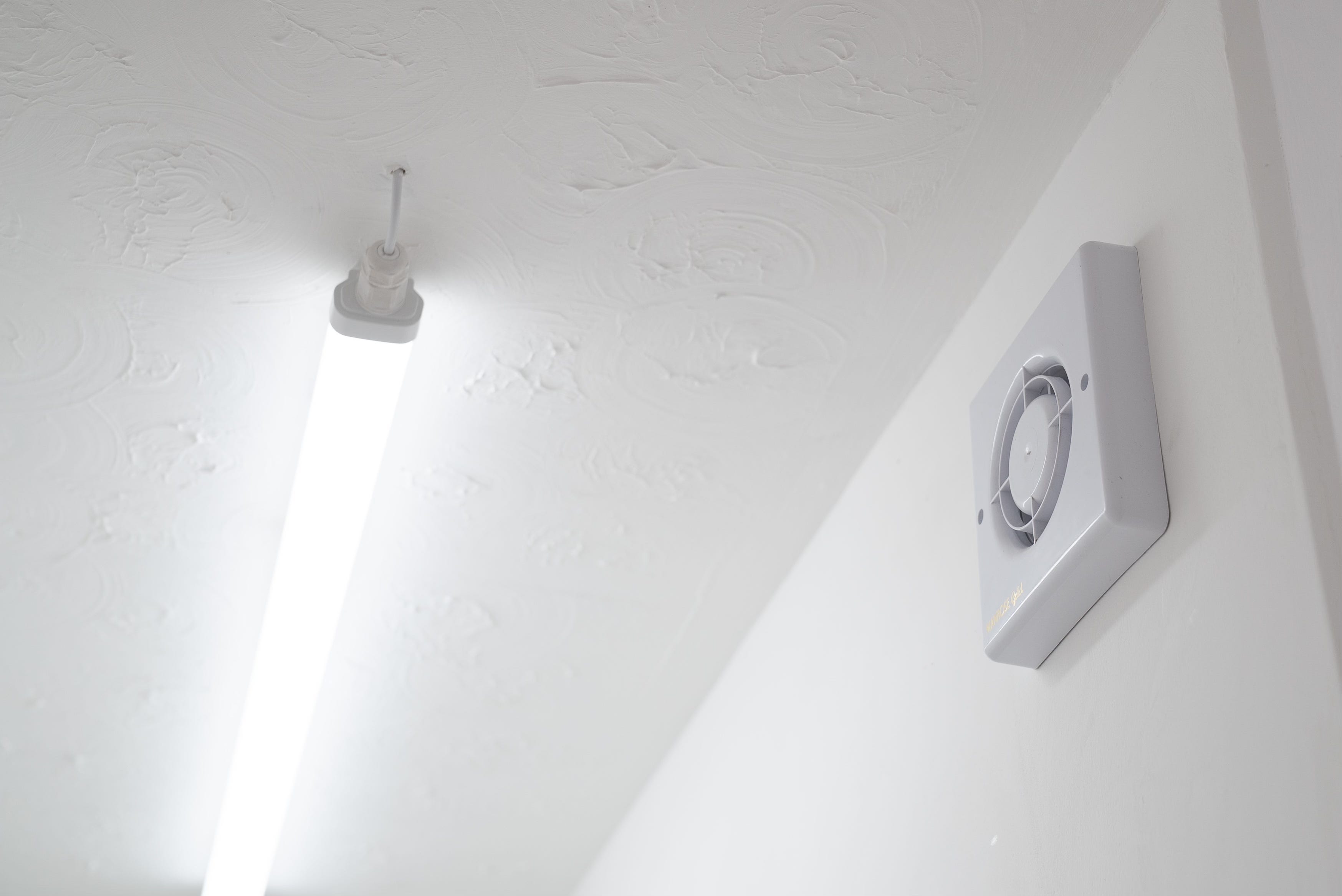
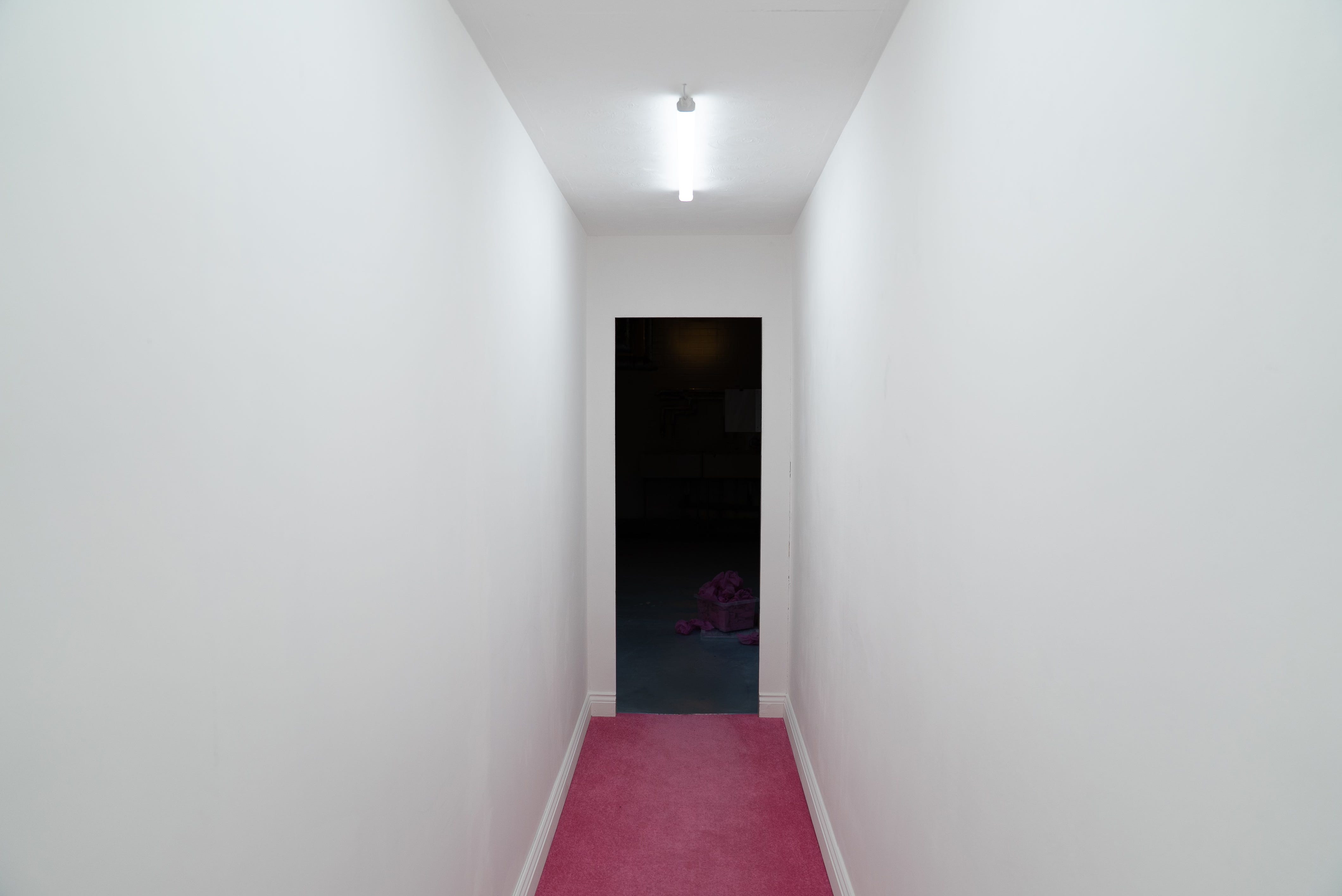
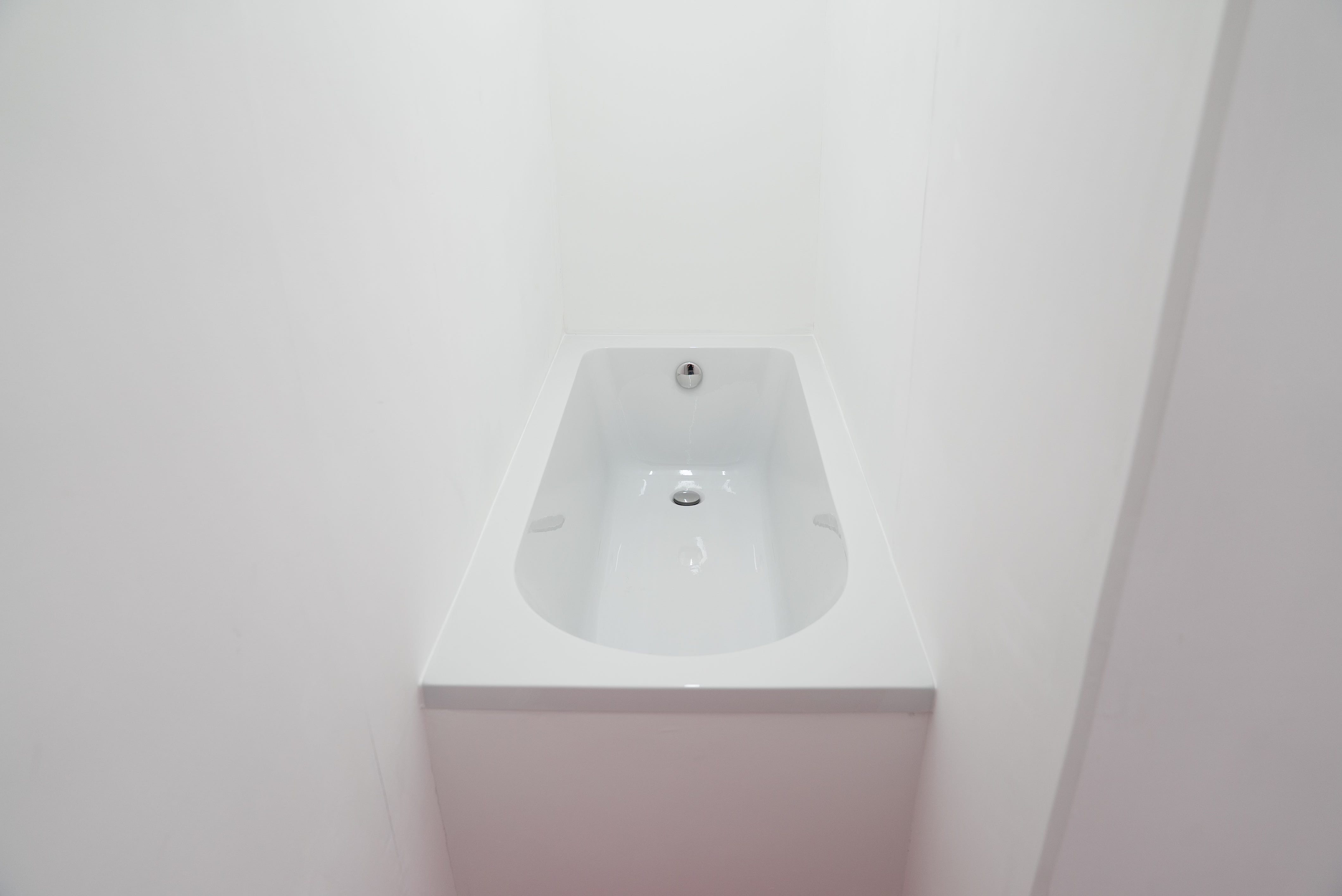
From the outside it is like a large, long wooden box. The inside is a long corridor with white strip lighting and pink carpet. The pink is really pink, blush pink, rose pink, dusty pink (how can I know the pink you are seeing in your mind’s eye is the pink I mean?). I put little dust covers over my shoes and tiptoe, the carpet is bouncy soft. At the end, the corridor turns right into a dead end filled with a bathtub. I’m staring it down lengthwise, ogling the silver cap on the plughole. Above, an extractor fan and an exposed bulb, long and thin and aggravatingly white. It casts dusty shadows and I can see that the ceiling has been artexed in painterly circles, hand-sized, blooming shapes.
As I look up, I breathe in — air freshener, cucumbers, springtime white blossom, floral bar soap, pale rose pink and blinding white, powdery light like cloud puffs and steam and fresh sheets and cucumber water. It smells like clean bathrooms, canned breeze, softsoftsoft and sweet. No, not sweet. Nice — is it possible to describe something (meaningfully) as nice? I think of nice as a lazy word. I use it carelessly, to avoid squeezing myself to find more precise words. I mean a deliberate pleasance, it is premeditated. The way made beds and folded towels are nice. There is labour in the artifice, in aiming to not disrupt or disturb, to maintain mundane enjoyment.
{Later, the artist tells me they formulated the scent themselves. It is called Bleach One. They point out the delivery mechanism — there’s a reed diffuser in a transparent plastic box, attached to the exterior wall of the room with a big industrial looking pipe. The extractor fan above the bathtub has been rigged up with a laptop fan, to push air from the pipe into the room rather than pull it out. The fan lends its name to the title (Manrose Gold is the name of a range of extractor fans for domestic use). And I think it is interesting: to alter something designed to pull things out (removing) so it does the opposite, and pushes something in (covering/masking). The artist tells me, I think notably, that they’re interested in smell as an invisible force that you can’t really ever consent to. You consciously notice the perception as you perceive it, by which time it is too late.}
I am thinking about smells that mask or coat other smells. The smell of bleach, but lemon scented. The smell of café toilets and the Glade plug-in that’s always somewhere in the corner. The smell of the hand soap in public bathrooms, hand soap that is always for some unknown reason the exact same pink as these carpets. The way all cleaning products have a flavour (lavender, ocean breeze, eucalyptus) and how I like it when people smell like fabric softener. I am thinking about loo goo that comes in a clicky tube; you can press the tube’s opening in the bowl of your toilet, click the button and it will deposit a ridged blob of purple or pink fragrant goo into the bog bowl so that every time you flush, you smell watermelon whirlwind instead of your own poo.
I am thinking about what it means to refuse to smell your own poo. Not that I want to actively seek out the smell of poo, but to go to such lengths to mitigate the possibility of an encounter with the smell of poo. Slavoj Žižek says shit is an excess that disrupts our metaphysical reality: the boundaries of our self are clearly defined, we go to the loo and plop out a shit, expelling it from the boundaried self. If we encounter it before we flush, I guess that encounter threatens that boundary. We are reminded that this poo was within our actual body, within our self; that we have expelled it means it is subject to our disgust, and here it is outside of us and refusing to leave, a dark shape lurking in the toilet bowl — it is the archetype of abjection, inhabiting the limbo between self and other, passing between both and disrupting their lines of demarcation. Milan Kundera says that kitsch is the denial of shit, a niceness so pervasive and deliberate that it obliterates the possibility of shit’s existence.
Loo goo is kitsch, a kind of mechanism of that denial. It allows us to deny the presence of what we have expelled. I feel like shit and poo is an extreme example, but I am standing in front of a bathtub, looking at it from the perspective of one sat on the toilet. Smells that mask or coat other smells are engaging in this artifice of cleanliness, how cleanliness is nice in that it deliberately denies the possibility of the body’s filth.
By this point, I am not in the carpeted blush pink tunnel. I am deep in some Proustian sense-memorial spin-out. At the heatwave’s pinnacle I had three cold showers a day because even in 36 degree stale summer I didn’t want to encounter the smell of my own dried sweat. I wanted to inhabit a state of constant blush pink coldness, as you would if you were fresh out of the shower. I’m thinking about how heatwave room temperature feels cold on wet skin. I’m thinking about my grandmother’s old house, which had blush pink carpets in the bathroom. By the bathtub, there was a rectangle of spare carpet that sat on top of the floor carpet, like a kind of extra-layer bathmat. I am thinking about the way wetness lingered, ever present.
KAJA UPELJ WITH ALINA MIRON, We Live in an Era of Saint Making, 2026, at the Goldsmiths MFA degree show
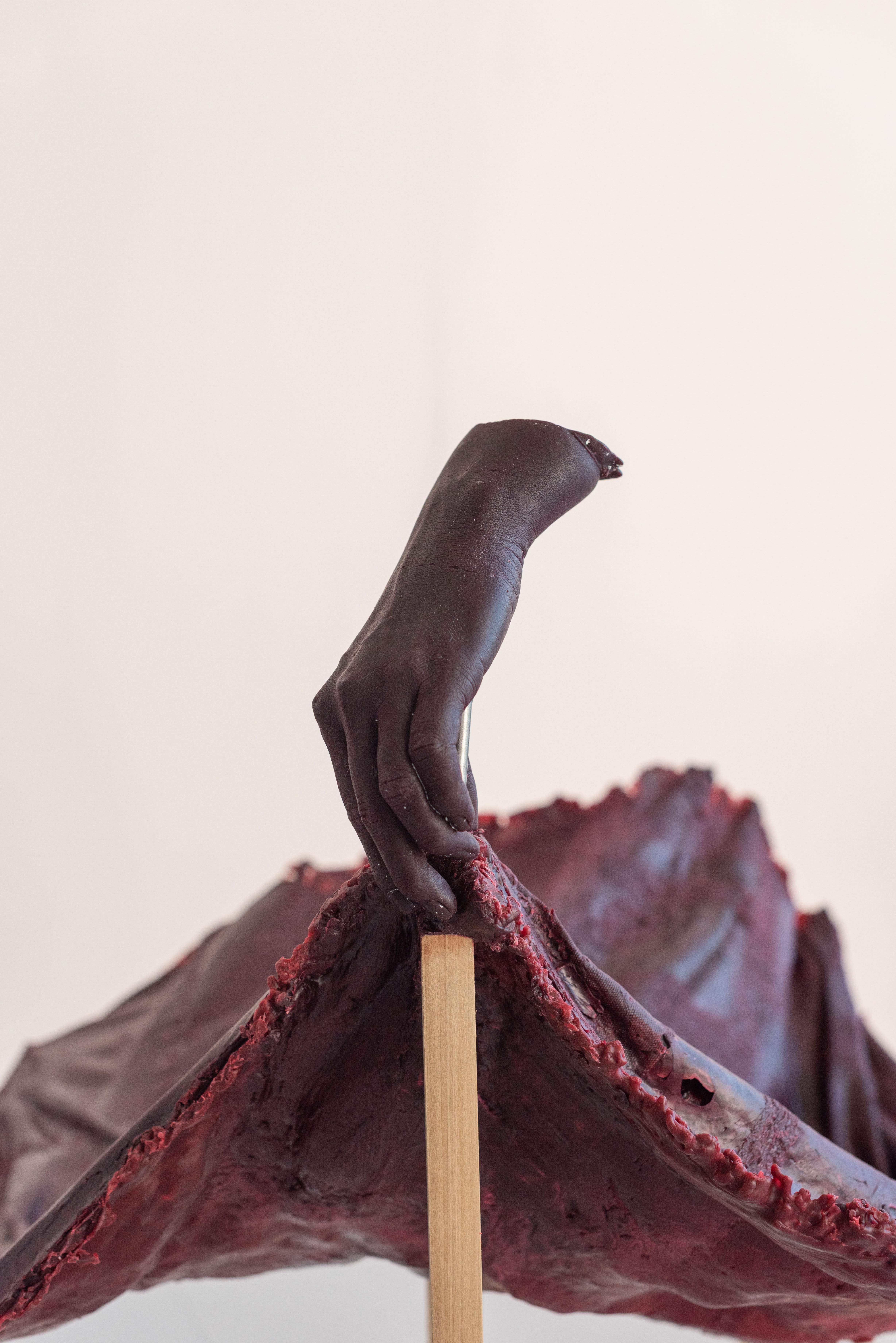
They’re bordered by two walls painted palm-of-the-hand pink and a floor to ceiling window. There are seven masses, wrinkled shapes. They are dark, oxblood red. They have a waxy dull shine like leather and they look dense, dried. They’re propped up by spindly wooden stilts, held aloft and floating at impossible angles. When I inch closer, they ripple and fold like fabric, like a skirt held up at the knees, the fabric bunching and pooling in on itself. The fabric dented with the imprint of lace, curling up and around the borders.
{Later, the artist tells me the shapes are chunks of a dress. The lace she imprinted into the surface was from her communion dress, previously her grandmother’s. It’s traditional Idrian lace from Slovenia, where she is from. It is a material that speaks to womanliness, women’s work, women’s inheritance. She is crawling inside these patriarchal vestiges and flipping them on their backs so we can see their tender tummies.}
{She uses the word anasyrma to describe the form, the lifted skirt, and on the train home I find the term on Wikipedia: the ritual gesture of lifting one’s skirt, deliberate, provocative, a form of jest, analogous to mooning. There is a separate heading explaining that through history it’s been seen as a gesture with supernatural effects: Pliny the Elder wrote that menstruating women can scare away hailstorms, whirlwinds, and lightning by lifting their skirts. Maimonides expressed his disapproval of this supernatural power, apparently this kind of ritual nakedness created a raw state closer to nature than society.}
I sniff, I huff. They are soap. I can smell the creaminess of soap, the lather. I can smell the thing underneath, the detergent. Like latex, like plasters, like rubber gloves, like hospitals. But that is so deep down — first, I smell spiced wine, amber, wood, smoke and fire and matches, the smell of burnt paper. I smell leather, the musky squeak of it. I smell smoke, I smell wood. I smell boxes — heavy, dark wooden boxes. I smell the inside of those boxes, the side of the timber that hasn’t been varnished, the side where the joint cuts are raw. It smells expensive, it smells heavy, it smells like pepper and age. It doesn’t smell fresh, it smells like something is lingering.
{The artist also tells me that she worked with a perfumer, Alina Miron, to create the scent in the soap. Kaja wrote a sentence describing how she wanted the smell to feel, gave it to Alina, and Alina made a fragrance in response. I ask her what that sentence was and she doesn’t remember, and I am glad — I am more interested in the sentence remaining a secret (to me and now also to you). Alina described the scent to me as ‘textural and unnerving’, an embodiment of the tension between the facets of womanhood. All the same, it remains mysterious, like a shared complicity or an inside joke between the two makers. I like the thought of that, this shared wordless understanding distilling into the work — scent and sculpture, mirror images either side.}
I can also smell cream, vanilla, and something milky within the box — hilarious, wait. I am confusing the smell of my own body with the smell of the soap sculptures. I smell like vanilla, I smell like milk and cream and cocoa butter. The smell of the soap is mixing with the smell of my own body and this dark, oxblood red, woody smell is crawling over my skin. I sniff my arm and I smell my own moisturiser and the arrival of something else. It is contagious, it slips under my recognition. It disarms me and catches me unaware.
After a while I stop noticing it, it is just the smell of the room and the bodies within it. I notice the other objects scattered around. Dark red fabric pooled on a vibrating pillow, a stiff lace glove with the middle and ring fingers pointing up, curling in. A dew drop shimmers between them. Two more soapy looking casts of hands, they are baby doll skin pink. One is curling two fingers up, the same as the glove, the other is pointing out with pointer and middle finger. There is a neon coral pink thread wrapped around the exposed fingers joining them up with a slip of silky satin that’s suspended from the ceiling. The material hangs like a strange flag, all mindless ripples, delicate folds and gathers, blossom pink and sexy.
I guess this is what I am failing to say and I don’t quite know why. There is an abstract sexiness on display in all these different forms. And it isn’t lewd or actually even about sex itself, it is just sensuous — of the senses rather than the intellect, of the body as a site of perception, information, sensation. The way the body constructs its own understandings without any need for systems of language. That isn’t a signal of some kind of feminine corporeal primitivism — I think it’s a sign that language is a kind of abstraction. Language creates understanding through the accumulation of rational connections. The body knows immediately.
I laugh to myself, thinking about how it can all be boiled down to a sentence, yet here I am stretching it out to 1000 words. I suppose, when we don’t know, rational language rushes in to fill the gap. I look at this work and I think about how I cannot really know it without touching it. Then I sniff again, and realise that it is creeping over me, coating my skin.

ELLA FLECK, aria, 2026, at the Goldsmiths MFA degree show
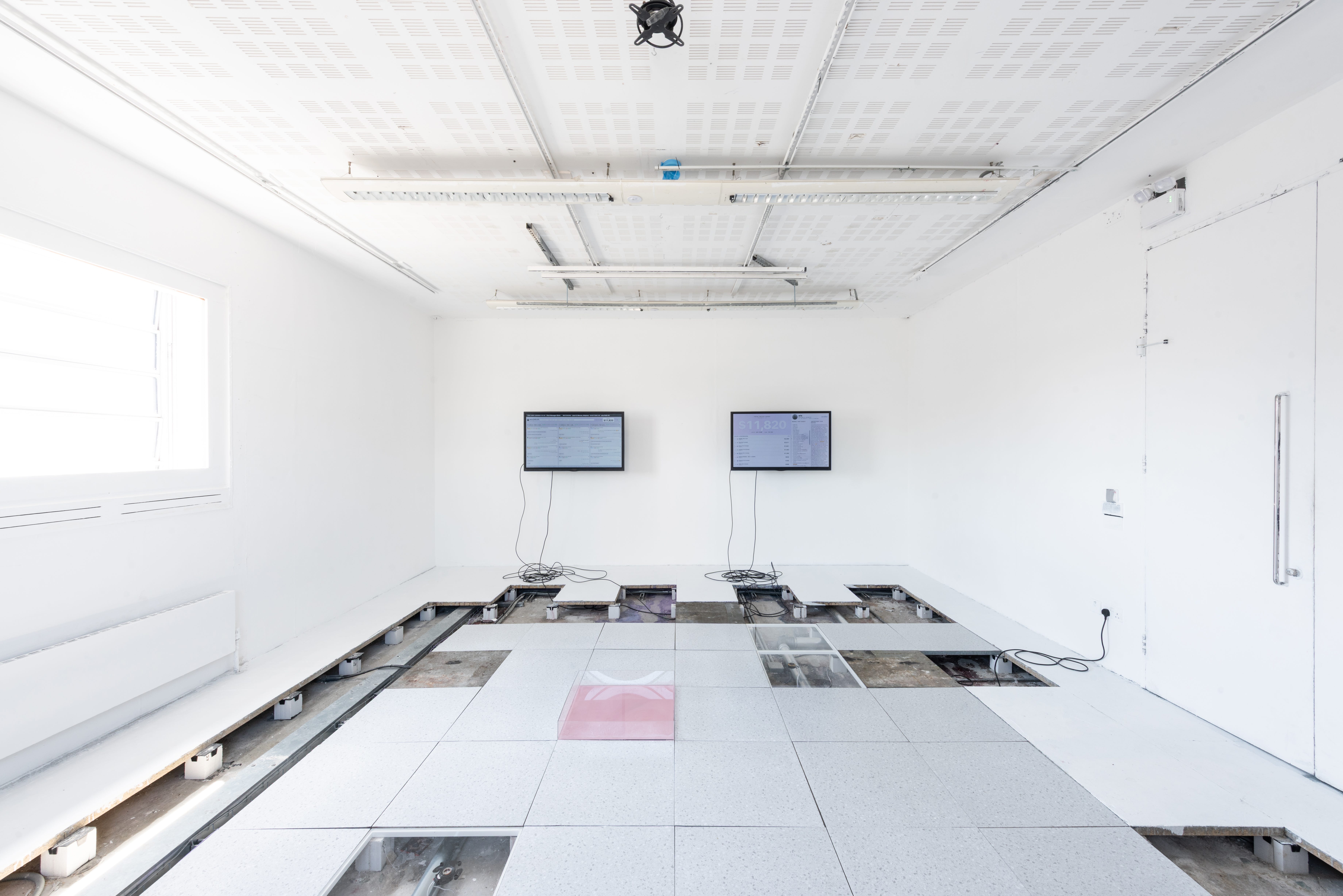
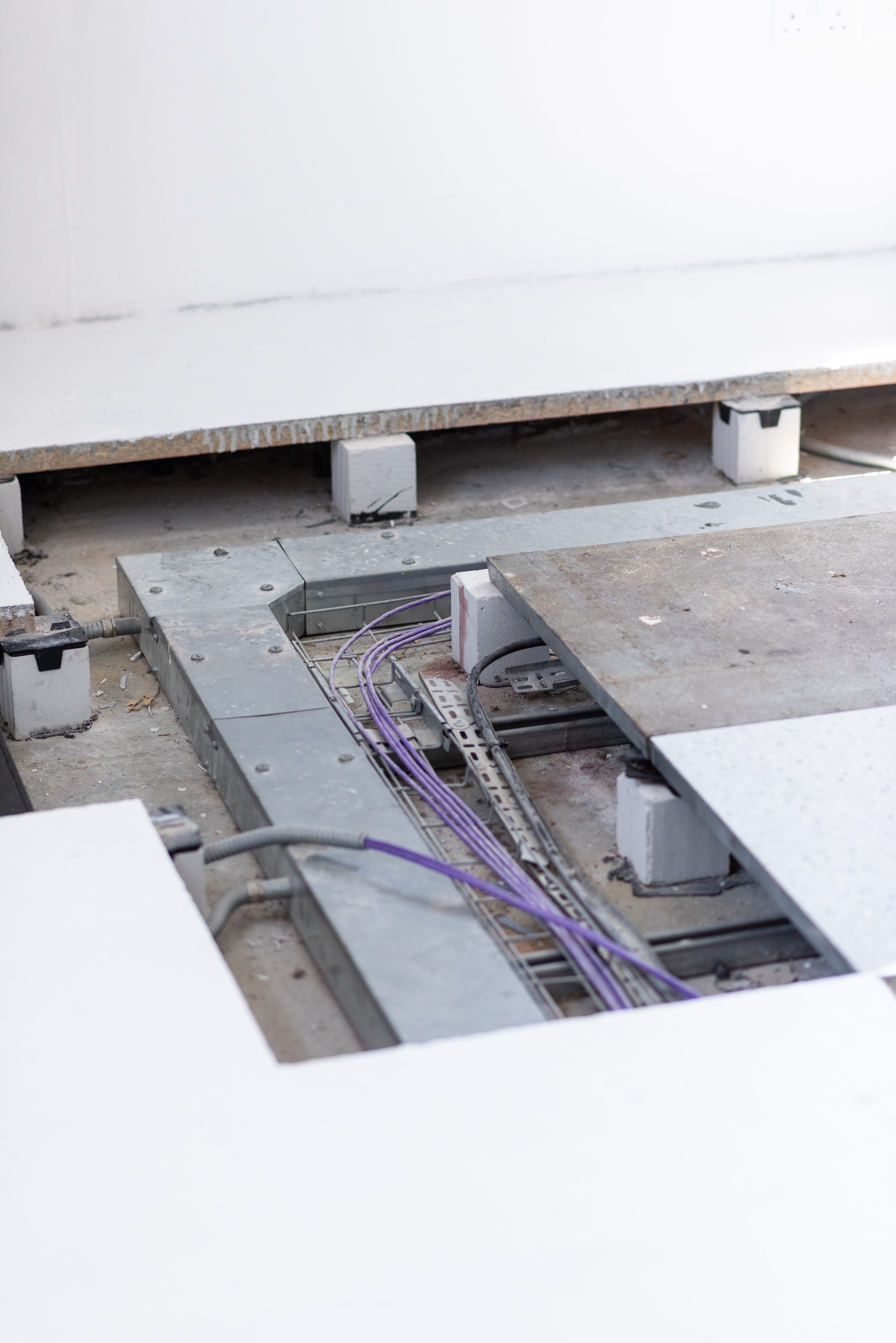
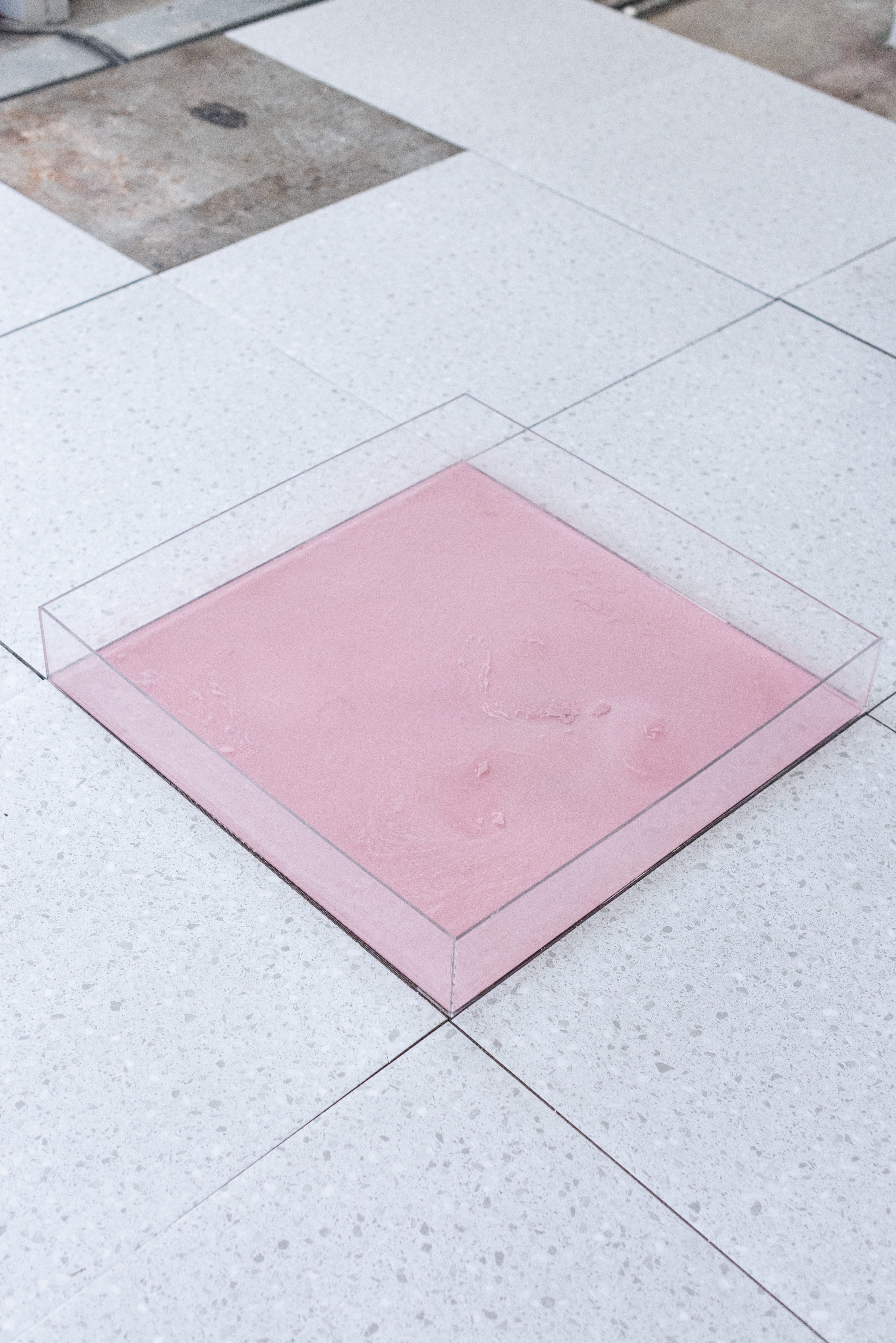
The door is closed for discretion and privacy. In here, the floor has been ripped up. Some of it has been replaced by square tiles, concrete or cast iron (I can’t tell through my shoes), clear perspex, some of it is just missing. Where it’s missing, you can see the metal wire covers and mystery pipes that run through the building. Long black wires thread in and out of the gaps too, and on the bottom of the clear perspex squares, little sticky vibrating speakers mumble out into the space.
There is one square right in the middle that has raised sides and I approach it carefully. Something ripples within it, murky pink like pasty lipgloss. I turn away for a bit, look at the two screens mounted on the wall. Behind me, someone enters and paces around, they walk straight over and put their foot in the milky pink liquid, and they gasp, I gasp. We watch as the murk rearranges itself around their shoe — it is shimmering, like blush, eyeshadow, nail polish. It has got sparkly mineral flecks that kick up and settle back down into the murk.
The disturbance releases a smell. Fake bubblegum, neon pink, and electric blue. So plastic and synthetic, obvious in its own fabrication. Like flavoured lube, lollipops, the smell of squishy toys, neon slime in plastic pots and gel pens and bubblegum-flavoured things that aren’t formally bubblegum or even actually consumable. It smells glow-in-the-dark, kind of bitter or sour, like soft play, like plastic, plastic, just like plastic — I think it is plastic? It doesn’t smell like plastic in the way crinkly see-through plastic packaging smells like plastic (and makes whatever is in it smell like plastic too), but like something soft and plastic that smells like someone has put something in the plastic to make it smell like something other than plastic (which is its own kind of plasticity, I guess). I breathe in, and it sticks. This is the kind of smell that stinks a bit, all acrid and sticky. Not overpowering, a chronic smell humming away like a bassline.
{The artist tells me that the smell is coming from a bubblegum-flavoured industrial deodoriser, the kind of chemical you put under floors when you need to disguise the smell of dead rats. And the metal panels and wires under the floor have been repurposed from data centres. The smell is part of a work spread across the floor, where we are made to stand on a kind of Big Tech summoning circle.}
{Later, the puzzle comes undone and I remember: the deodoriser smells like those bouncy rubber balls that were slightly translucent and lurid in primary colours. They had faces on so they looked like giant emojis and were bubblegum-scented — the smell rubbed off on your hands as you bounced them and they sold them in the café at the leisure centre where I learned to swim.}
In a way, the smell is not the point, it’s just background noise. There is a note on the wall, explaining: this work came out of a period of undercover research where the artist posed as a man named Eliott. Eliott did 6 weeks of training as a Chatter for Stellar Op OnlyFans Chatter Agency — a company that hires men across Europe to impersonate female models and chat with the fans in these women’s OnlyFans DMs.
The two screens show two Chatter dashboards.
On one side, a notes app handbook where chatters keep notes on each model: their favourite food, their measurements, the place they really want to travel to, their favourite sex position, the emojis and abbreviations they use when texting. And notes on each fan: their name, their location, their hobbies, their emotional states, their kinks and desires, the minutiae of their lives (Ali, lives in Western Australia, older and works in construction, not confident about himself, wants real time sexting but can’t afford it, tried adding guilt but DON’T PUSH) all extrapolated and detailed from interactions.
On the other: a CRM app with nine chats open, we watch as the Chatter Eliott is shadowing bounces from one chat to the other, mimicking the text/sext tone of Aria, the model whose account he has been assigned to. Some of the conversations are confrontational: do people even pay for this? / do you feel proud of this? / helllooooooooo????? / boring / more explicit tbh. Some are funny: I don’t have any money I don’t even have a job, I’m just horny and I love you / pweaseeeee mommy / I like pussy I’m a good boy I pwomise. Some are interpersonally crazed, as fans confess their love for Aria, say they can’t subscribe anymore because it pains them to see her sell nudes etc. to other men. Some of them are genuinely banal: one chat window scrolls through a day’s worth of messages with a WHALE VIP who speaks about his job, his various trucks and all their names, asks Aria to write him a poem.
These chatters exist to do the grunt work, chat with these men and squeeze as much profit out of their subscriptions as possible by upselling them on exclusive paid content. They teeter between sexting, sales patter, and the universal customer service voice that you get whenever you call up BT or O2. The aim is to be completely covert, and the illusion shatters if any of these men realise they’re not actually texting Aria.
This feels like the point: sex work is work, obviously, and so it is subject to the same derangement as all other forms of labour under capitalism. We are watching peak neoliberalism: the cracking open of a new market (interpersonal intimacy and romance) for Real Hustlers to milk dry. This is not the Love that bell hooks was writing about, this is How To Win Friends and Influence People. It’s the underhand subliminal force of customer service and sales speak and it is making me feel nauseous. The hard sell always does! I feel that salespeople are fundamentally morally bankrupt (just like estate agents and QVC presenters and anyone that goes on The Apprentice) because they can never just come out and say: I NEED YOU TO BUY THIS FROM ME! And that has always struck me as a very frustrated mode of operating. Repressing the desire to express an explicit intention for fear that it’ll spook the flow of a sales pipeline. Maybe all business is morally bankrupt because it all involves some kind of pressure tactic or underhand strategy. Saying that makes me feel naive. But standing here in the midst of a full day’s worth of rolling sales chat, networked by data centre wires, huffing in the smell of fake bubblegum that’s meant to disguise the smell of something else — I can’t help but feel like there are dead rats under the floorboards, I just can’t see or smell them. This is the internet’s most egregious misinformation campaign. We think it is immaterial, in the cloud (like air, like scent particles) but actually it is a data centre, a server farm, it is diverting 60% of your town’s local water supply, it is melting the icecaps and starting wildfires, it is a bubblegum-scented office with a suspended ceiling, with dead rats under the carpet tiles. There is a dread within me, seeing the ways that Big Tech has captured a new market to keep us all glued to our screens and away from each other.
AND, SO
Mediums don’t actually need to be fixed, do they? Maybe it’s all relative, maybe smell is an inherently unfixable medium, maybe no mediums can ever be fixed (and wait— what even constitutes a medium?) but AH!
I think to try and join the dots is a fool’s game. These three artists use smell in such different ways, to such an extent that it feels like they’re almost using different mediums. James Milner’s invisible gas insidiously creeps up on you, unfolds before you realise what’s happening. Kaja Upelj and Alina Miron have made a parallel language, something with body and presence, that can step up and hold you in its strong arms. And then Ella Fleck’s found object, nose-based readymade, is more about setting the scene — only to lift the lid on a niche corner of the world, charting lines between intimacy and neoliberalism.
Even as I was huffing in the whiff of each work, the smells would change from one sniff to the next. It’d be pink then blossom then clouds then air freshener then loo goo then actual poo then something else, something else, something else — all in the space of twenty something seconds. Smell shoves you into your body with a violence that resists language, makes language feel like a kind of derangement, or makes it insufficient, obsolete. I am glad — the instability of it guarantees my interest. This nebulous thing, slippery gas, ephemeral, invisible, intangible. Passing over me like a cloud, all I can do is scrabble for the words, all you can do is take my word for it.
Zarina Muhammad will be in conversation with the artists on 16 September 2026, 6.30pm at Camden Art Centre (Arkwright Road, London, NW3 6DG).
Register here.